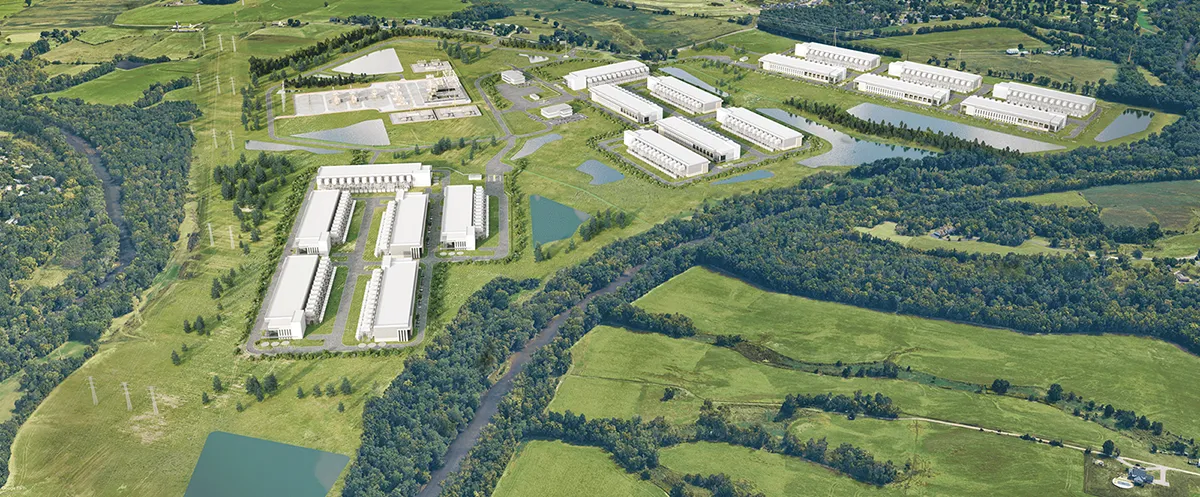
A data center is a building that houses computer servers, disk drives, networking equipment, and other compute-related hardware. When you store something “in the cloud,” it’s actually being stored in a data center somewhere instead of directly on your phone, computer, or other device.
It’s important to note that the data centers of today are not the same as data centers twenty years ago. A data center is no longer just some building that a company uses to store proprietary data. Instead of simply holding a company’s data, they may churn data belonging to thousands, maybe millions of customers, running nonstop and fueling the global digital economy. This means that these data centers also have massive power and water requirements for running and cooling those servers.
Hyperscale data centers are staggering energy consumers. The project slated for Middlesex Township is designed for 1.35 gigawatts (GW) of capacity, with the option to expand to 1.8 GW (PowerHouse Data Centers). To put that in perspective, 1 GW can power about 750,000 homes (CNET). At full load, this single data center could draw as much electricity as all 112,477 housing units in Cumberland County TEN TIMES OVER (U.S. Census Bureau).
This scale of demand doesn’t just strain the grid. It risks prioritizing industry over residents. Rates are already being affected by new data center loads, as utilities pass on infrastructure and transmission costs to ordinary customers (via More Perfect Union on YouTube). Backup diesel generators used for testing also raise air quality concerns for surrounding communities.
Townships don’t decide to build data centers themselves. Instead, a developer buys land and submits a plan to the township for approval.
The Board of Supervisors (in second-class townships) or the Board of Commissioners (in first-class townships) has the final say on whether to approve a developer’s plan. For more detail on these boards and other roles, see our Municipal Government overview.
Before reaching the board, plans often go to the Planning Commission, which reviews proposals and makes recommendations. In some cases, projects may also come before a Zoning Hearing Board if variances, exceptions, or zoning changes are required.
One important point: if a data center is permitted “by right” under existing zoning, the township has little room to reject it. Denial in that case risks a lawsuit from the developer.
There is bipartisan support for data center construction. That means we need bipartisan opposition. We are circulating a pledge that we will neither vote for or support elected candidates supporting data center development. Regardless of what office they’re running for. If they want our votes let them stand up to big tech! Let’s send a message that while we all come from different backgrounds and believe different things, one thing unites us: we love our homes and want to protect them!